Motivation and stress in sport
1. Introduction: Why motivation matters in youth sports
Today, children and young people are growing up in a society characterised by increasing performance demands. In many contexts, they are expected to perform well academically, socially and in sport. In sport, this can lead to feelings of pressure and, in some cases, dropout if the focus is one-sidedly on results rather than on development and community.
Research indicates that motivation is largely developed in environments where children and young people experience security, recognition and meaningful relationships. When the teaching environment supports these factors, children are more likely to participate actively, develop confidence in their own abilities and continue participating in sport over the long term.
We have created an environment where well-being and sporting development go hand in hand. When children and young people feel seen, recognised and gradually given responsibility within the community, their motivation is boosted. In this module, we present an approach to training where the aim is to motivate rather than to stress.
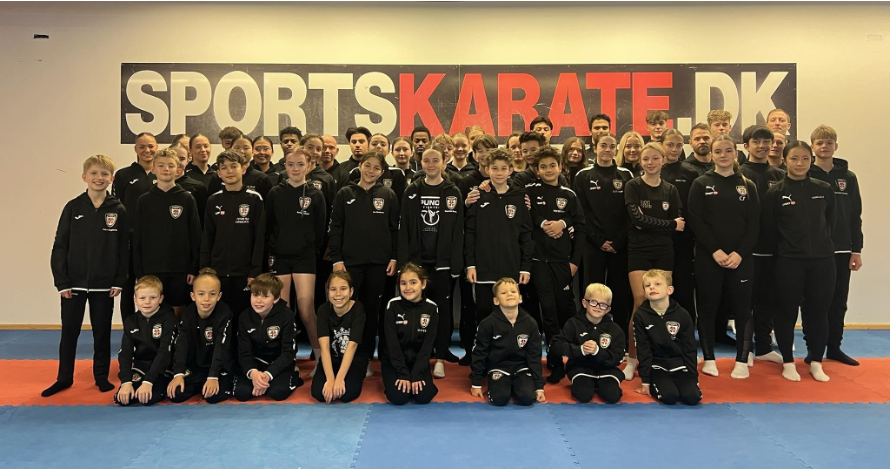
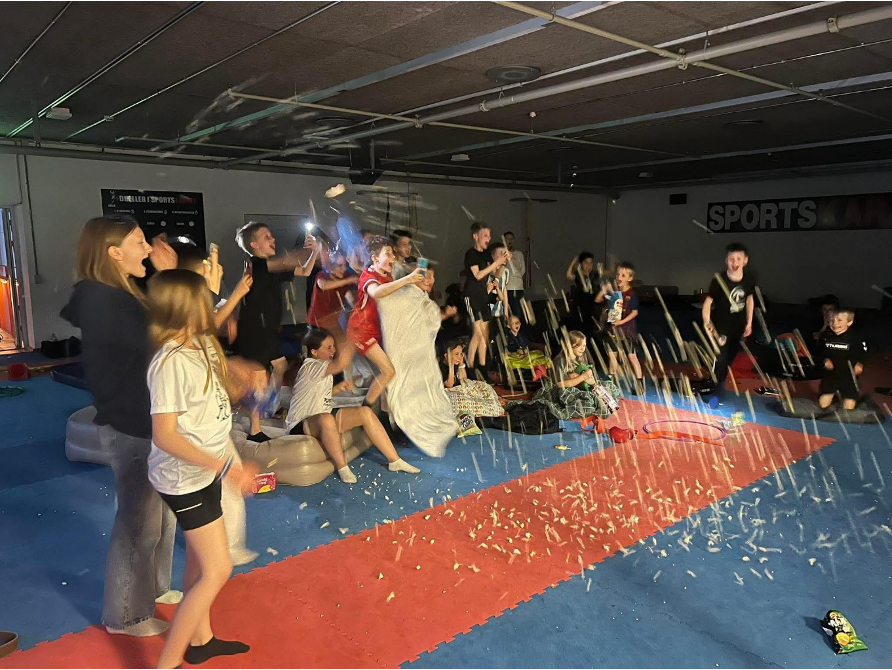
Photo from the 2025 Danish Championships camp Photo from the Club Camp in 2025
2. The flipped hierarchy: building motivation through responsibility
We operate on the basis of a flat structure and what we call an inverted hierarchical model. This means that the most senior karatekas and instructors have a particular responsibility to support and develop those who are newer to the environment. Experience confers not only status, but also a responsibility to contribute to the community. We call this the Inverted Sportskarate Triangle (The Flipped Sportskarate Triangle).
A safe start is important to us, which is why it is the most experienced members who teach the club’s youngest members. We know that children’s first experiences can be crucial in establishing a strong connection and a desire to continue for many years to come. We encourage our youngest members to practise exercises with each other, or with siblings and parents. In this way, we boost motivation and participation, even among the club’s youngest members. Another benefit is increased awareness of karate, our unique values, and the barriers that often arise for our youngest members after a long day.
At the same time, the club’s elite athletes are a natural part of everyday life in the training environment. They take part in the training sessions and serve as role models for the younger karatekas. In this way, experience, responsibility and community become closely intertwined, and motivation emerges as a natural part of the environment.
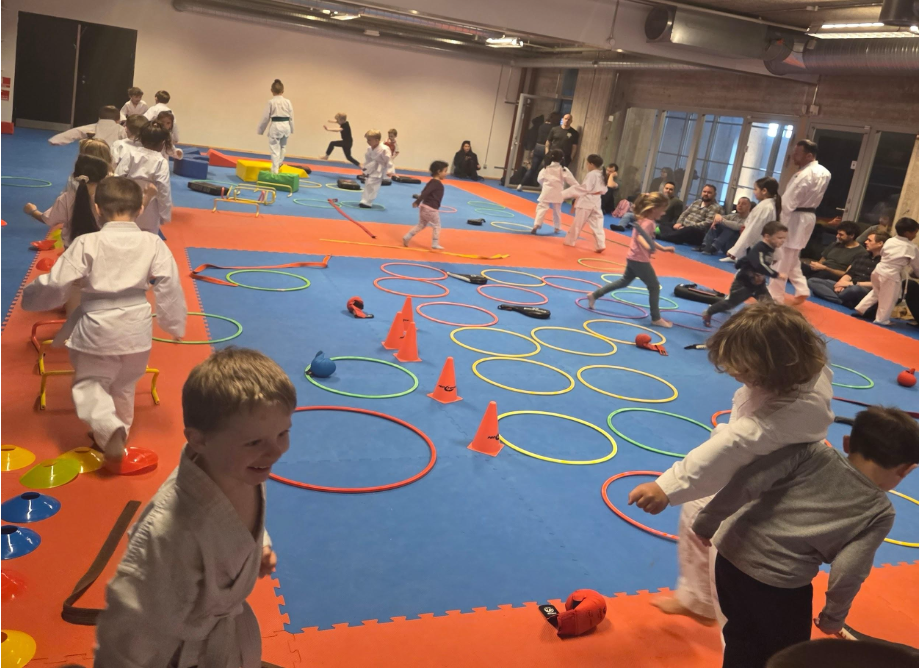
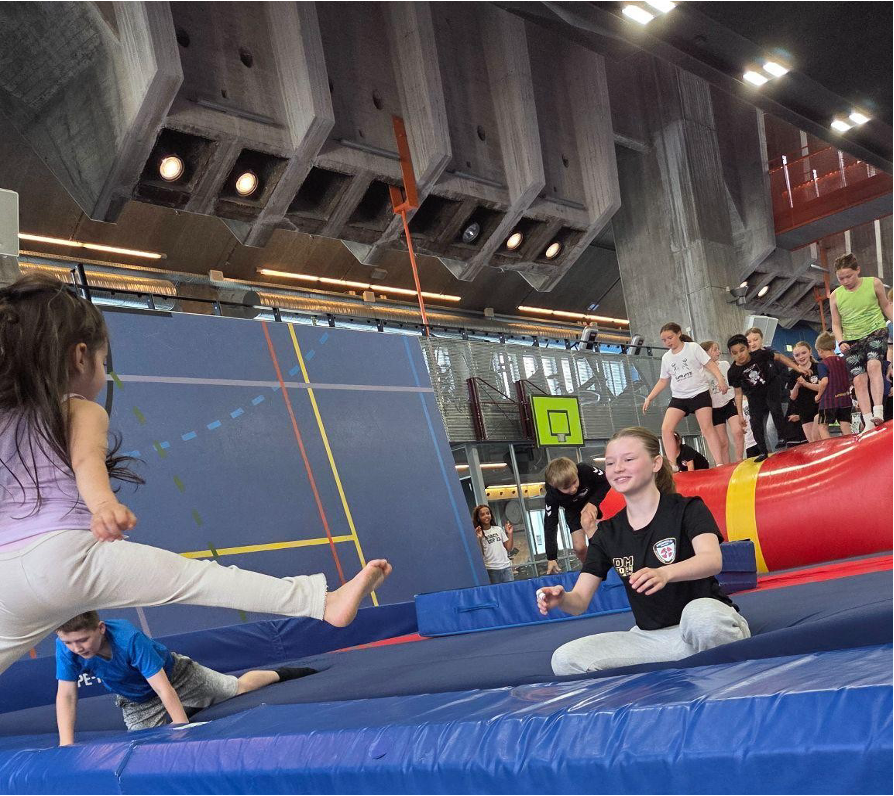
Photo from the youngest team, taught by the head coach. Photo from Club Camp 2024, older members playing with the youngest.
3. Strong relationships as the foundation for motivation
We prioritise stable relationships as a fundamental aspect of the training environment, with a particular focus on relationships between the children. This means that we actively support the children in getting to know each other and becoming part of a community where they form friendships.
When children form relationships with one another, a different kind of connection to training develops. We find that children continue to attend because their friends are there too. This means that motivation is linked not only to the activity itself, but also to the community around it.
Therefore, we use exercises and frameworks that foster cooperation and interaction between the children. We also ensure that there are enough “helping hands” in the form of assistant coaches. Research shows that motivation is boosted when children feel a sense of belonging. That’s why we focus on peer-to-peer relationships and a positive experience as a central part of the training.
When children develop relationships with one another, the community becomes something they themselves help to sustain. This creates a stronger connection to the training and makes it easier to maintain motivation over time. Assistant coaches and instructors play an active role in connecting the children and ensuring that no one is left out.
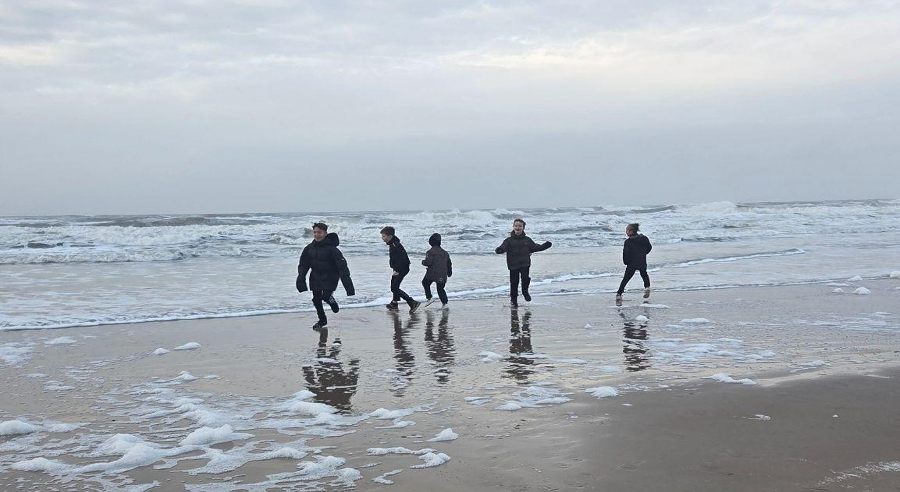
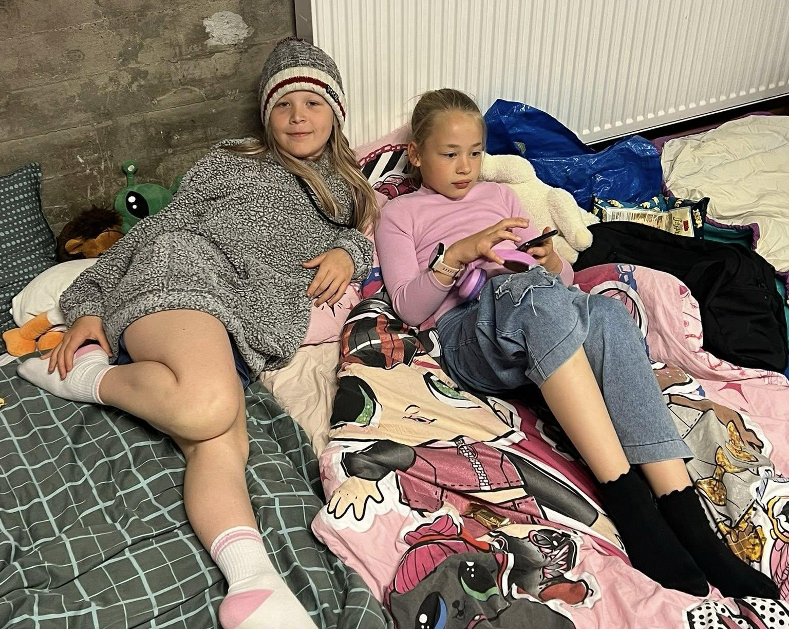
Photo from Club Camp 2025
4. Apprenticeship learning: how coaches are developed
We employ what we call “apprenticeship learning”, whereby new instructors develop through hands-on participation. Assistant coaches are children and young people who want to take responsibility and contribute to the community. They take part in teaching sessions alongside more experienced coaches and learn through observation, participation and gradually increasing responsibility.
Developing as a future instructor is not just about technical skills, but to a large extent about interpersonal skills. We place emphasis on the ability to see others, create a sense of security and make a positive contribution to the community. Therefore, coaching potential is assessed on the basis of both professional and personal qualities.
Through mentoring, young people are given the opportunity to develop into the role of instructor at a pace they can manage. They feel that their contribution matters and that they are an important part of the community. Young people learn not only from adults but also from each other, and development takes place within relationships. To a large extent, the older members serve as role models for the younger members.
5. Goal-Focused Language Strategies
In our teaching, we employ a goal-focused communication strategy, which places the emphasis on what children and young people should do, rather than on what they are doing wrong. In practice, this means that we often refrain from correcting mistakes the first few times and instead provide guidance towards the desired action.
This approach creates a calm learning environment and reduces the perception of pressure. Children are given the opportunity to practise without being constantly assessed, which increases their willingness to participate actively. We use language that looks ahead and supports development, rather than highlighting shortcomings.
When we discipline children, we generally do so with humour and a twinkle in our eye. This enables us to maintain structure and boundaries without creating unnecessary distance or insecurity. Even when expectations are set, they are experienced as part of the community and not as an external sanction. We view mistakes as a natural part of learning. When children and young people feel that they are allowed to make mistakes and try again, their courage and perseverance are strengthened.
At the same time, we work to make the goals clear and specific for the children, so they know what they are aiming for. This creates a sense of progression, where children can feel their own development, boosting both motivation and engagement.
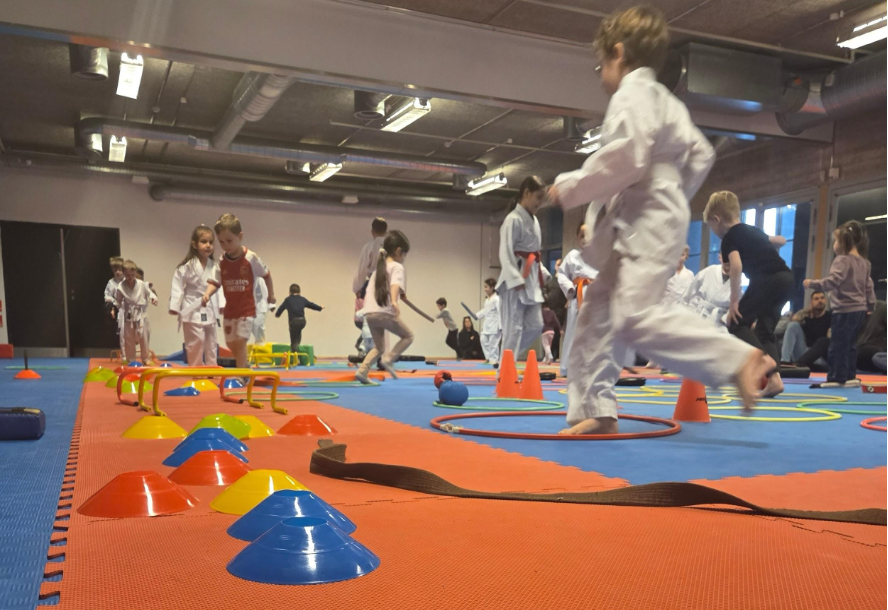
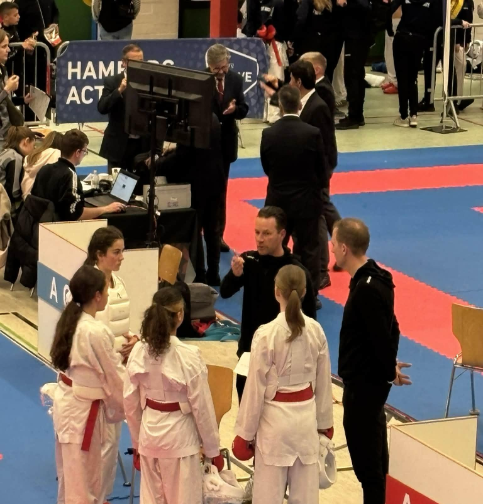
Images from Goal-Oriented Communication 2026
6. Role models and a community culture
We consciously work with role models as part of the training environment. Young assistant coaches and experienced athletes play an active role in teaching and are visible in day-to-day activities. This gives younger children someone to look up to and creates a natural link between the different levels within the club.
These role models embody the culture we want to create. They demonstrate how to participate in the community, take responsibility and contribute to others. They are not only the most skilled competitors, but also members who are adept at building relationships and creating a sense of security.
We practise “learning by doing” and teach older members about their potential. We expect healthy habits and appropriate language. A good example of these values in practice is that we do not allow energy drinks at Sportskarate. Instead, both young and old can have an ice lolly (popsicle). These active choices all have an impact on the overall culture. Alcohol, smoking, snus and vaping are strictly prohibited.
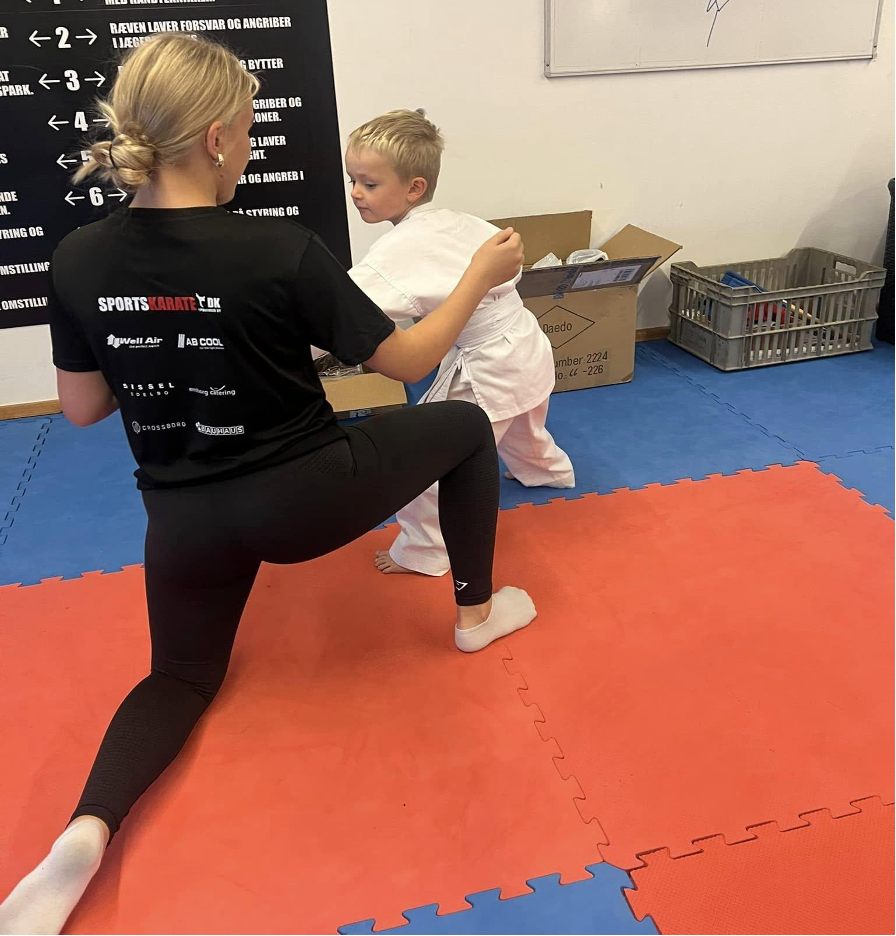
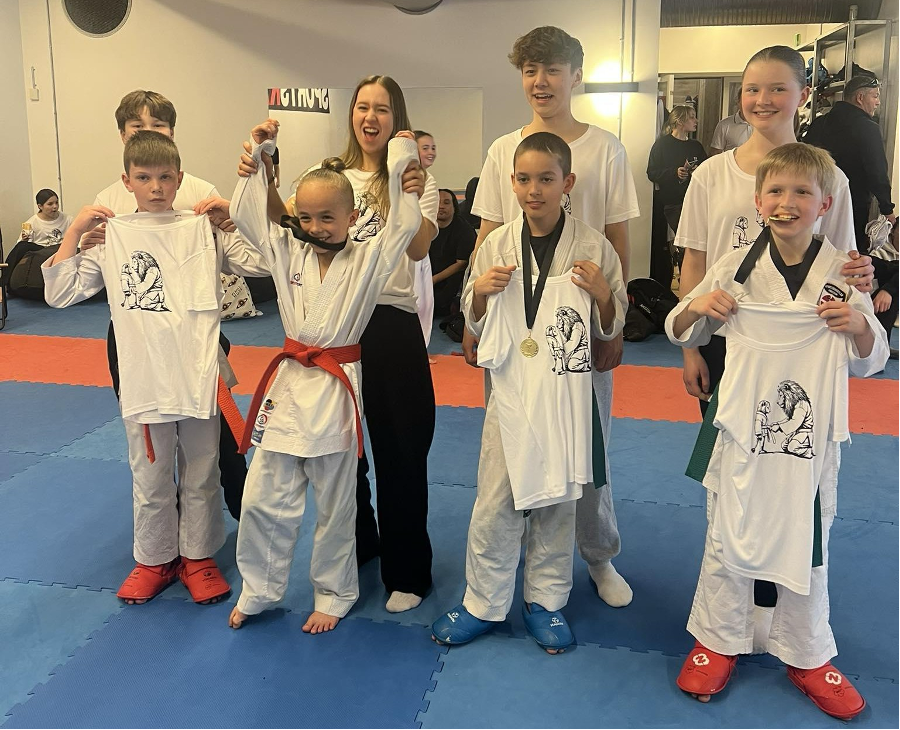
Photos of the role models at Sportskarate 2025
7. Building intrinsic motivation
We focus on strengthening intrinsic motivation rather than managing through external pressure. This means that we place emphasis on effort, commitment and development, rather than on results alone. Children and young people are expected to participate actively and take responsibility for their own development.
When their efforts are recognised, children see that it pays to try and to keep going. This builds confidence in their own abilities and a desire to develop further. At the same time, motivation becomes something that arises from within, rather than something that is imposed from outside.
In practice, this means that we strive to observe and acknowledge the individual development of each child. It is not a requirement that a child be skilled in order to receive positive attention. We have assistant coaches and instructors who work closely with the children, providing support as they take small steps and helping them to adjust and improve their movements along the way. When a child tries, participates or takes a small step forward, they are met with recognition, making it easier for more children to stay engaged over time.
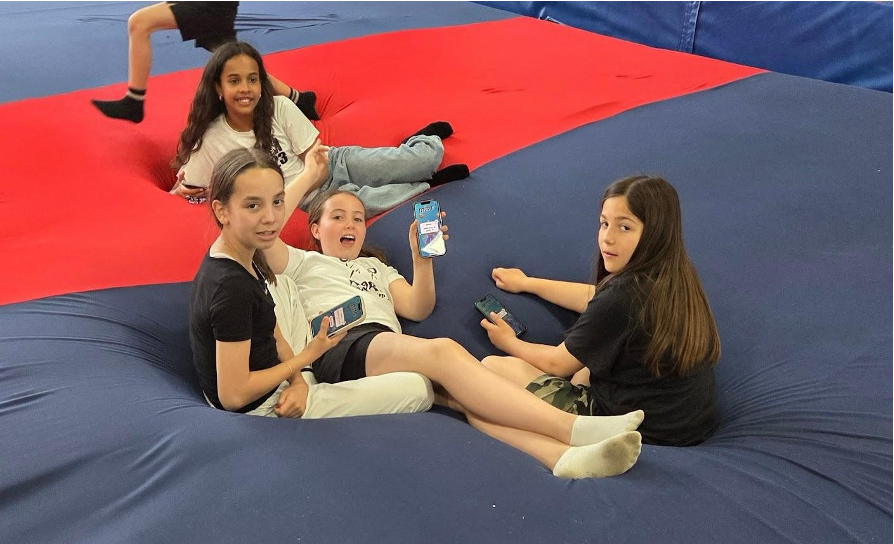
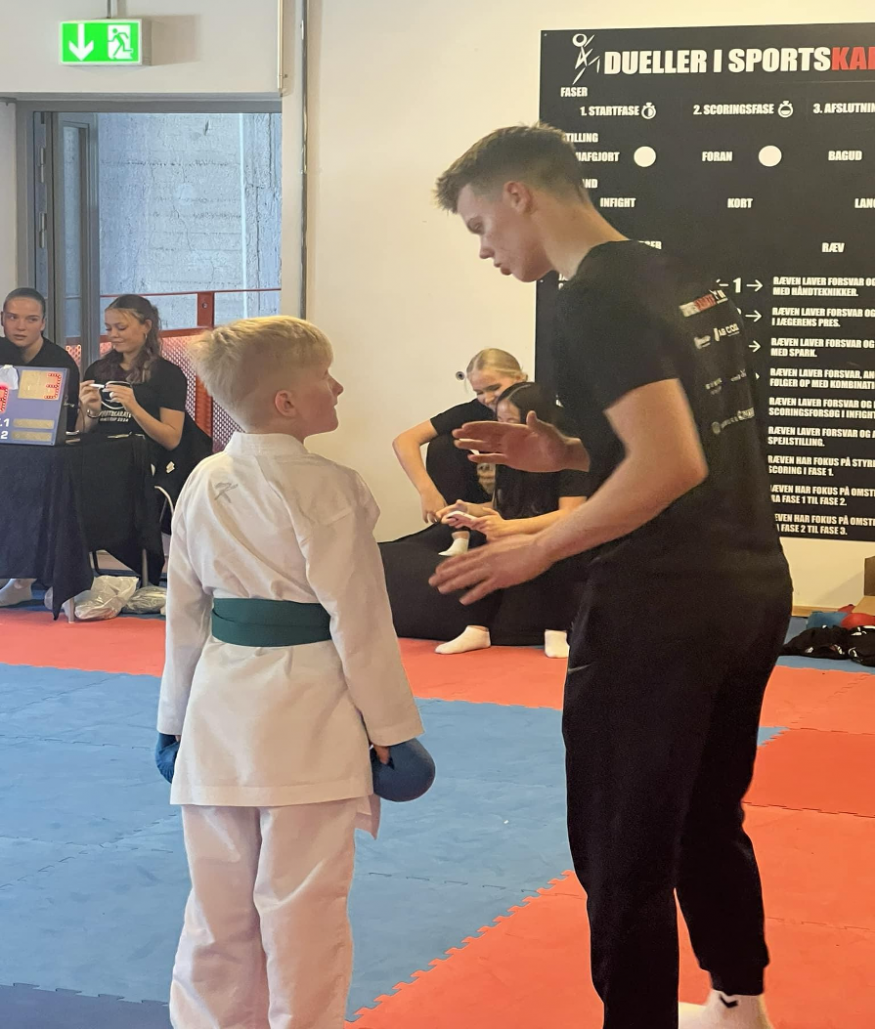
Participation and development in various ways 2025
8. Graphic models
In collaboration with other organisations, Sportskarate has developed a range of tools to be used in training and to foster a positive culture. Not all internal workflows and tools are presented as models and diagrams. However, it is our goal to make as many processes as possible visible and to visualise them.
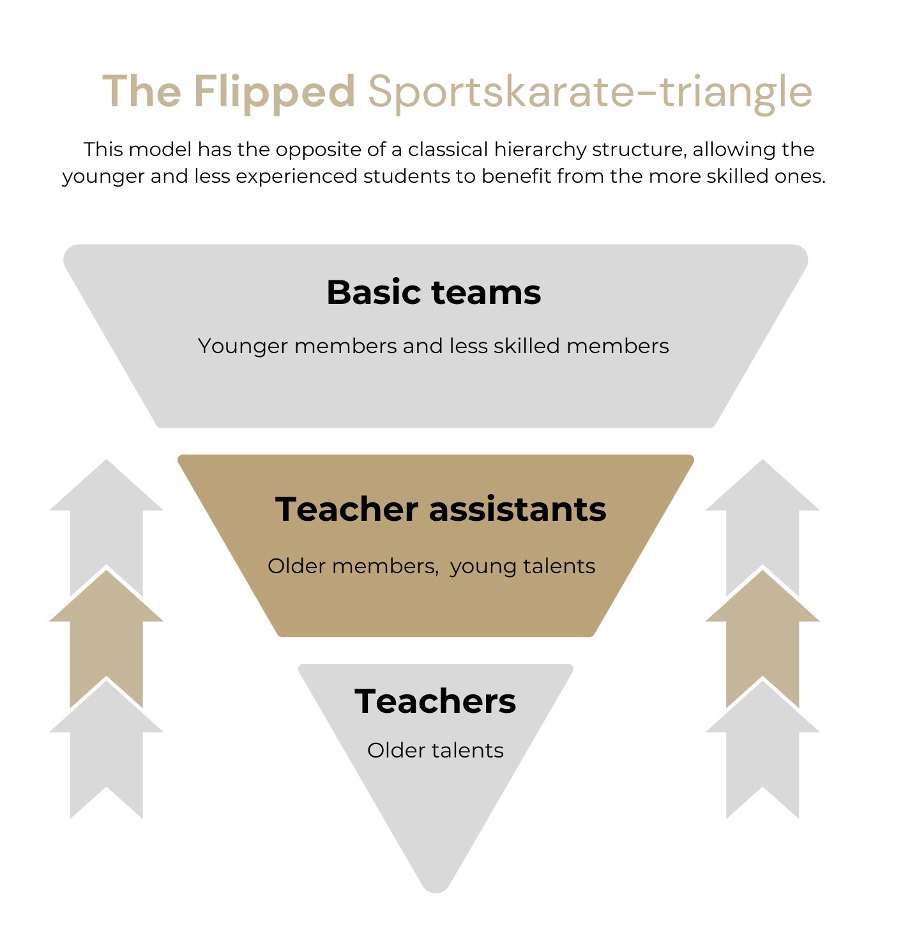
Model developed in collaboration with Relationsværkstedet 2025
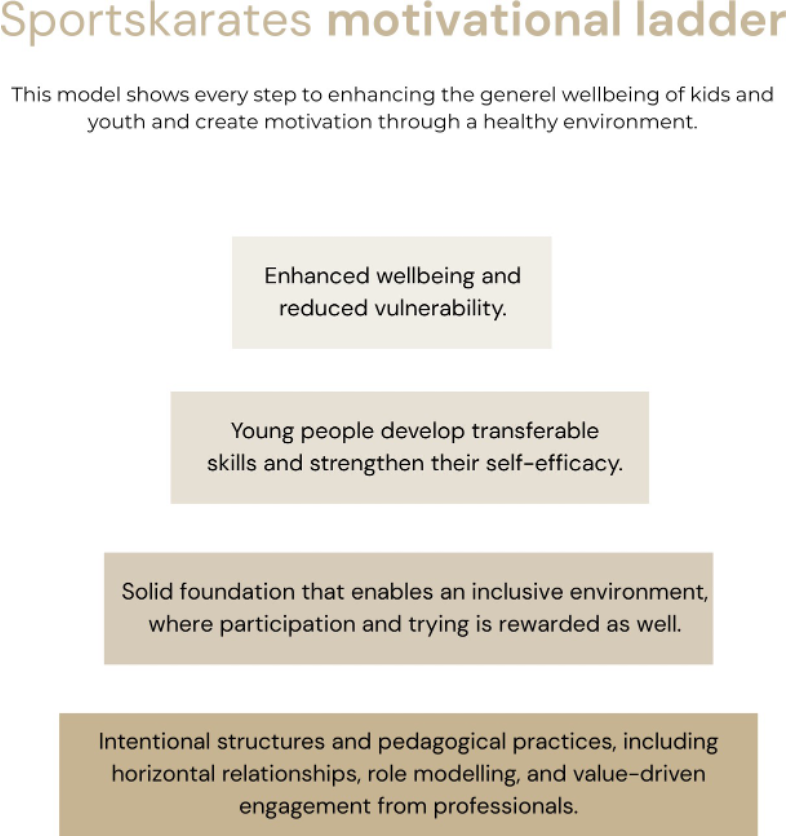
Figure developed in collaboration with Relationsværkstedet 2025
9. Coaching principles (practical summary)
A key element of the foundation is an ongoing desire to learn and develop. We actively monitor international developments and trends in both sport and education, and new knowledge is continuously incorporated into our training. This applies not only to technical developments, but also to views of children and understandings of well-being.
This foundation allows for methodological freedom in teaching. Teachers can employ different approaches, but always within a shared value framework characterised by an appreciative approach. A high margin of error is accepted, with mistakes viewed as a natural and necessary part of learning. Some teachers adopt a clear and positive error culture, while others work with a strong focus on “towards-language”, where children are guided towards what they need to achieve. This approach creates an environment where children and young people encounter a community where they can participate while learning, and where it is acceptable to be a work in progress.
10. Key takeaways – motivating instead of stressing
- We actively help foster relationships between the children so that they want to come back.
- We ensure that all children and young people are acknowledged and supported, especially when they are not yet able to do something themselves.
- We acknowledge effort and small steps forward, not just when things go well.
- We provide more forward-looking guidance rather than criticising mistakes.
- We give children and young people responsibility at an early stage and allow them to contribute to the community.
- We use assistant coaches to be close to and support each individual.
- We allow a high margin for error, so it is safe to try again and again.
- We establish clear boundaries, but also leave room for play and energy.
- We stop ourselves when we feel the urge to reprimand and try to be creative.
- We operate on the basis that it has to be fun – otherwise, we will lose them. We adopt a “yes” mindset and create space for play and a flexible framework.